A part may appear technically convincing in CAD, yet in reality, it can fall short in terms of weight, stiffness, surface quality, or reproducibility. The reason often lies not in the material itself, but in the vertical integration of manufacturing of the chosen partner. Therefore, the selection of a composite manufacturer determines early on whether a design becomes a robust series production part, a precise motorsport part, or merely a visually appealing prototype.
For purchasers, development departments, and motorsport teams, carbon is not a standard material. Fibre orientation, resin system, tool concept, curing cycle, and post-processing are all interconnected. Those who evaluate these factors separately overlook the true performance of a composite manufacturer: translating requirements into a controllable manufacturing process.
How to Identify a Capable Composite Manufacturer
The first question is not whether a supplier can process carbon. The crucial factor is whether they master the appropriate process for the part’s function and control the process chain themselves. A visible carbon diffuser, a structural bracket, a body panel, and a highly stressed motorsport support place fundamentally different demands on laminate structure, tolerances, and testing effort.
A qualified manufacturer therefore doesn’t talk about square meter prices first. They ask about load cases, installation space, quantity, temperature range, mounting points, required surface finish, and approval environment. For projects targeting the US market, requirements for packaging, transport safety, documentation, and potentially customer-specific test or material certificates are added. These questions are not a sales ritual. They determine whether design and manufacturing align from the outset.
Special attention should be paid to the vertical integration of manufacturing. If design, mould making, tool manufacturing, lamination, and post-processing are distributed among several service providers, coordination effort and error risk increase. A partner with in-house process responsibility can assess changes more quickly, implement tool corrections precisely, and trace deviations to their root causes.
Composite Manufacturer Selection Begins with the Application
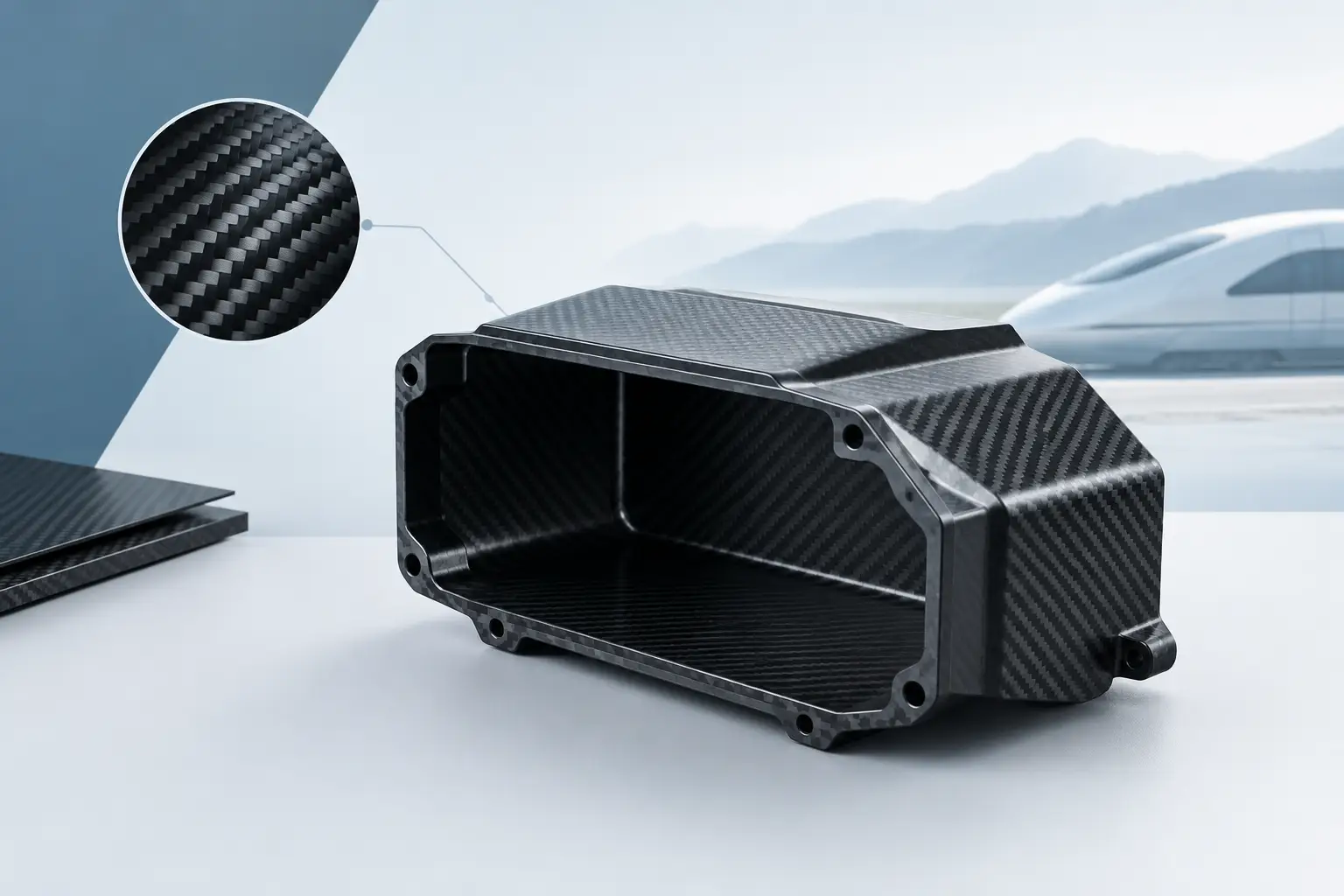
The best technology is never universally the most economical. It must suit the part and its task. For high-quality visible parts, in addition to low weight, fibre pattern, surface smoothness, edge quality, and UV-resistant paint finish are paramount. For technical structural parts, however, defined strength, stiffness, reproducible fibre orientation, and reliable load transfer are key.
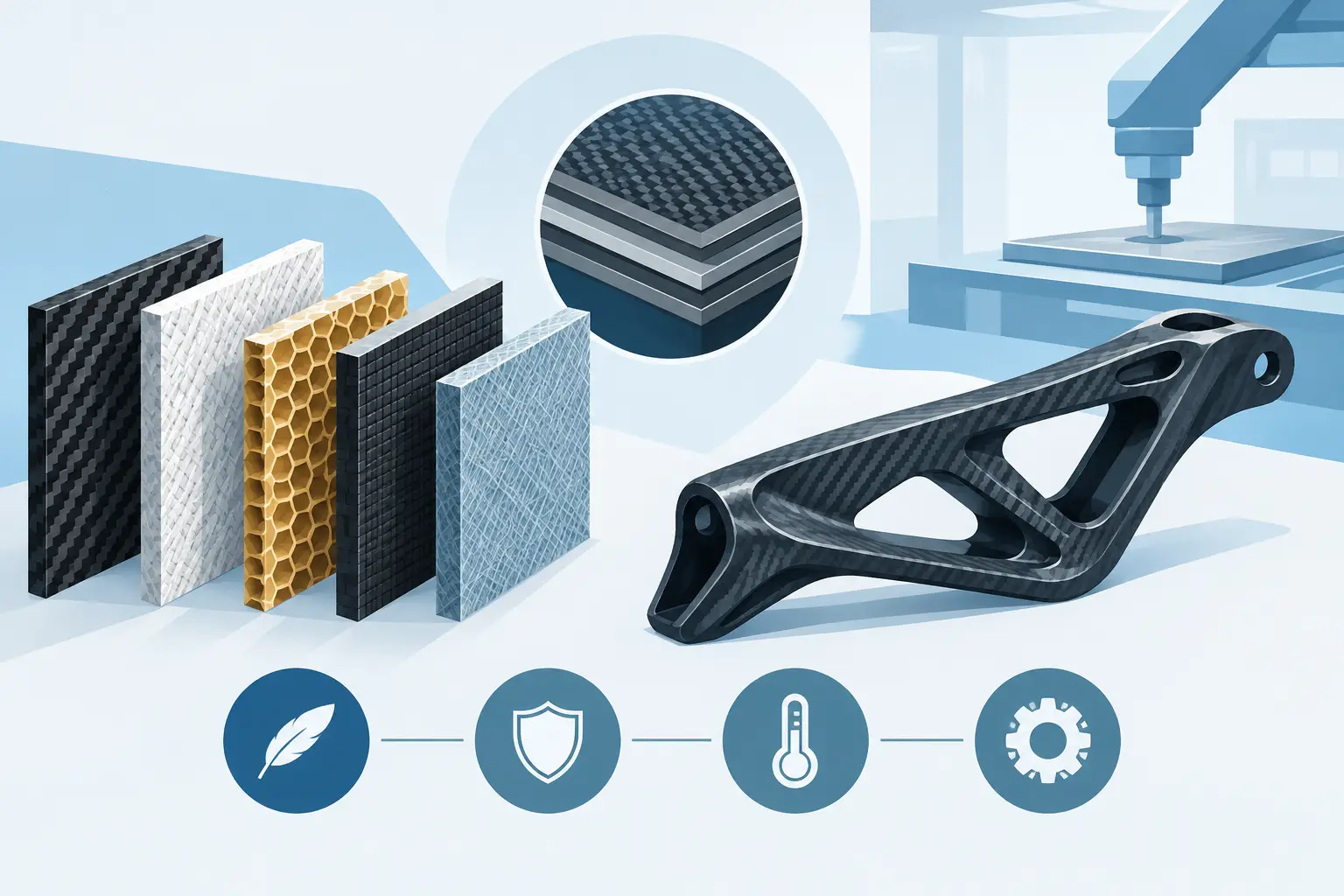
Especially in the automotive and motorsport sectors, this is often underestimated. A part with an identical outer contour can be constructed completely differently depending on its application. Should it absorb aerodynamic loads, dampen vibrations, withstand heat, or fulfill a defined crash and fracture characteristic? Only from these considerations do material selection, core material, local reinforcements, and the necessary insert solutions emerge.
For small quantities, a simple solution is not automatically cheaper. A less precise process can lead to higher rework, fluctuating part weights, and scrap. For small series, a well-designed tool often pays off if it ensures stable tolerances, cycle times, and surface quality. Conversely, a highly complex tool might not be appropriate for a one-off development part. Good consultation makes this conflict of objectives transparent.
Process Depth: Why Prepreg and Autoclave are Relevant
For demanding carbon parts, the prepreg autoclave process is a central quality benchmark. Prepreg fabrics have a predefined resin content. This allows for more precise control of laminate structure and fibre volume than with many open or purely manually impregnated processes. Under vacuum and defined pressure in the autoclave, the composite is consolidated and cured at a controlled temperature.
The result can be very low void content, high fibre content, and consistent part quality. These properties are relevant when both weight and mechanical performance need to be maximized. Equally important is the visual aspect: for visible carbon, precise tools, clean cuts, and controlled processes support a uniform, high-quality fibre pattern.
However, this process has clear prerequisites. Prepreg material requires consistent cold chain and storage logistics. Tool design must withstand pressure and temperature, and cycle times must be carefully planned. For high-volume standard parts or less critical fairings, other processes may be economically viable. A reputable manufacturer recommends autoclave technology not as a label, but where the required part performance justifies the effort.
Quality is Evident Before the Finished Part
Many suppliers present flawless surfaces. This alone does not prove technical quality. True process reliability is established even before the first cut: through understandable design data, manufacturing-friendly draft angles, defined parting lines, sensibly placed inserts, and a tool concept that supports the subsequent laminating process.
For complex parts, the manufacturer should be involved in the development phase. This allows problematic radii, inaccessible areas, or unclear mounting concepts to be identified before they trigger expensive tool changes. Coordination is particularly crucial for parts with metal or aluminum inserts. Different thermal expansions, load peaks, and corrosion protection must be considered in the design.
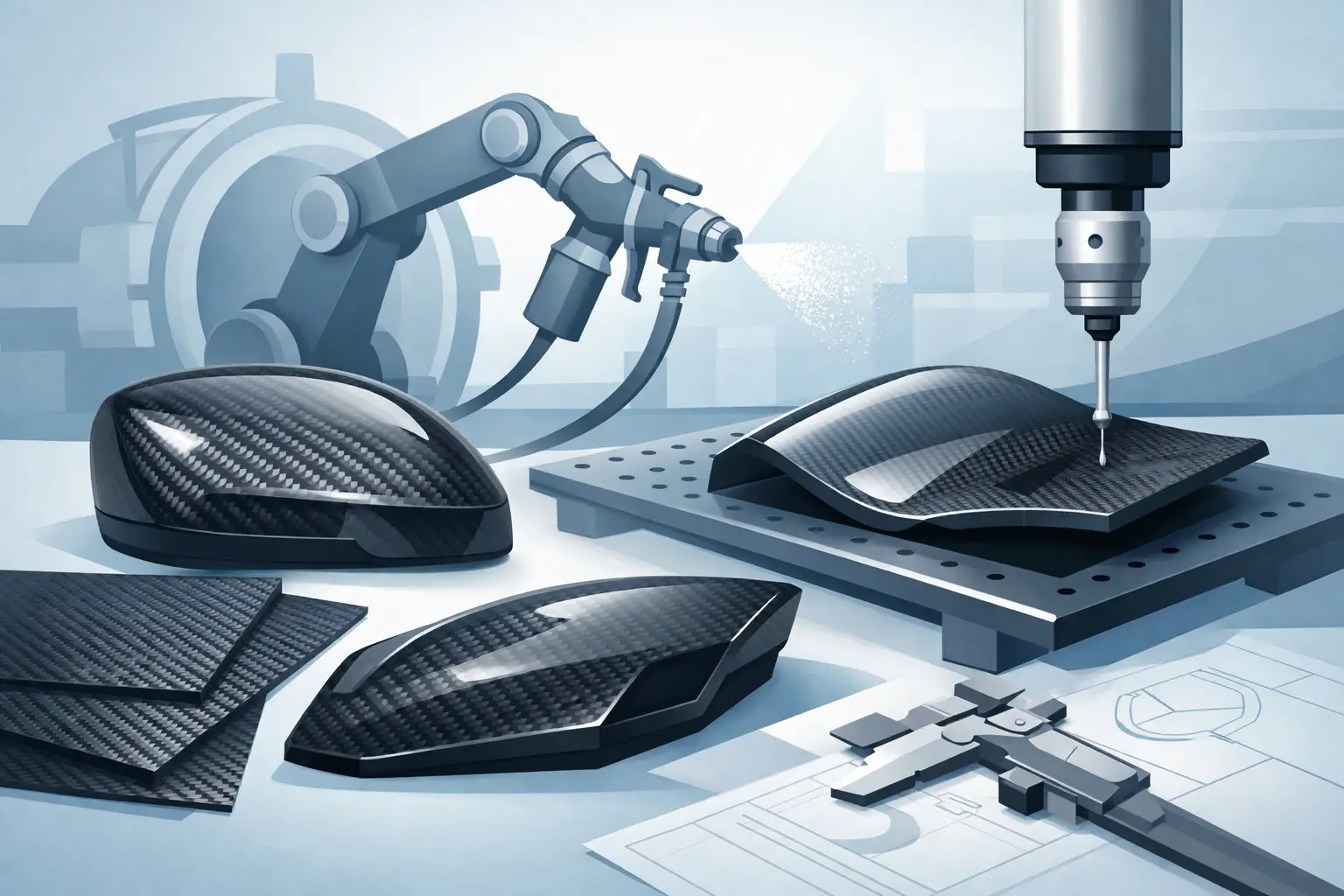
Post-processing also deserves concrete clarification. CNC trimming, drilling patterns, edge sealing, and mounting surfaces influence function and interchangeability. If these steps are performed with reproducible fixtures, fit accuracy and part quality remain stable even in small series. Manual work is not contrary to precision. It is indispensable where an experienced eye evaluates fibre orientation, surface details, and final quality characteristics. The key is that manual work is secured by clear standards and suitable measuring equipment.
The Right Questions Before Awarding a Contract
A reliable supplier evaluation requires concrete answers. Ask about comparable part sizes and load cases, available plant technology, and the procedure for prototype changes. Also clarify who is responsible for moulds and tools, how parts are inspected, and what documentation is possible for material batches, processes, and final approvals.
For procurement across continents, operational reliability is also important. For US customers, clear packaging concepts, traceable delivery dates, and clear communication regarding export procedures are just as relevant as the laminate itself. A high-quality carbon part loses value if it arrives unprotected, requires rework, or is not integrated into assembly on schedule.
Caution is advised if a supplier describes material, process, and costs only generally. Statements like “100 percent carbon” or “handmade” say little about fibre quality, resin system, core structure, or compaction. Extremely short delivery times can also be a warning sign for complex moulds if there is no verifiable capacity and tool planning behind them. Reliability arises from realistic planning, not from blanket promises.
From Prototype to Small Series Without Quality Loss
The transition from a one-off part to a small series is one of the most challenging phases in a composite project. An initial prototype can be convincing through intensive manual rework. For repeatable series quality, however, cutting plans, laminating sequence, vacuum setup, curing parameters, processing, and testing must be documented. Only then will the tenth or fiftieth part be comparable to the approved sample.
Here, the value of a manufacturer with in-house development and production becomes particularly clear: insights from the prototype flow directly into the tool, process parameters, and testing concept. This reduces interfaces and prevents critical knowledge from being lost between design, mould making, and production. Composite World has been connecting these steps since 2002 for individual high-performance applications – from functional prototypes to precisely repeatable small series.
Ultimately, a good selection decision is not based on a single process or quoted price. It depends on whether the manufacturing partner understands the function of your part, openly identifies technical trade-offs, and ensures quality throughout the entire process. Those who involve this expertise early on create the foundation for carbon parts that not only impress at first glance but also perform reliably under real-world conditions.