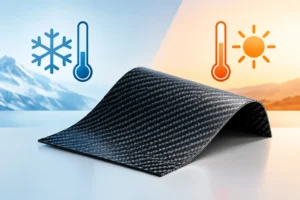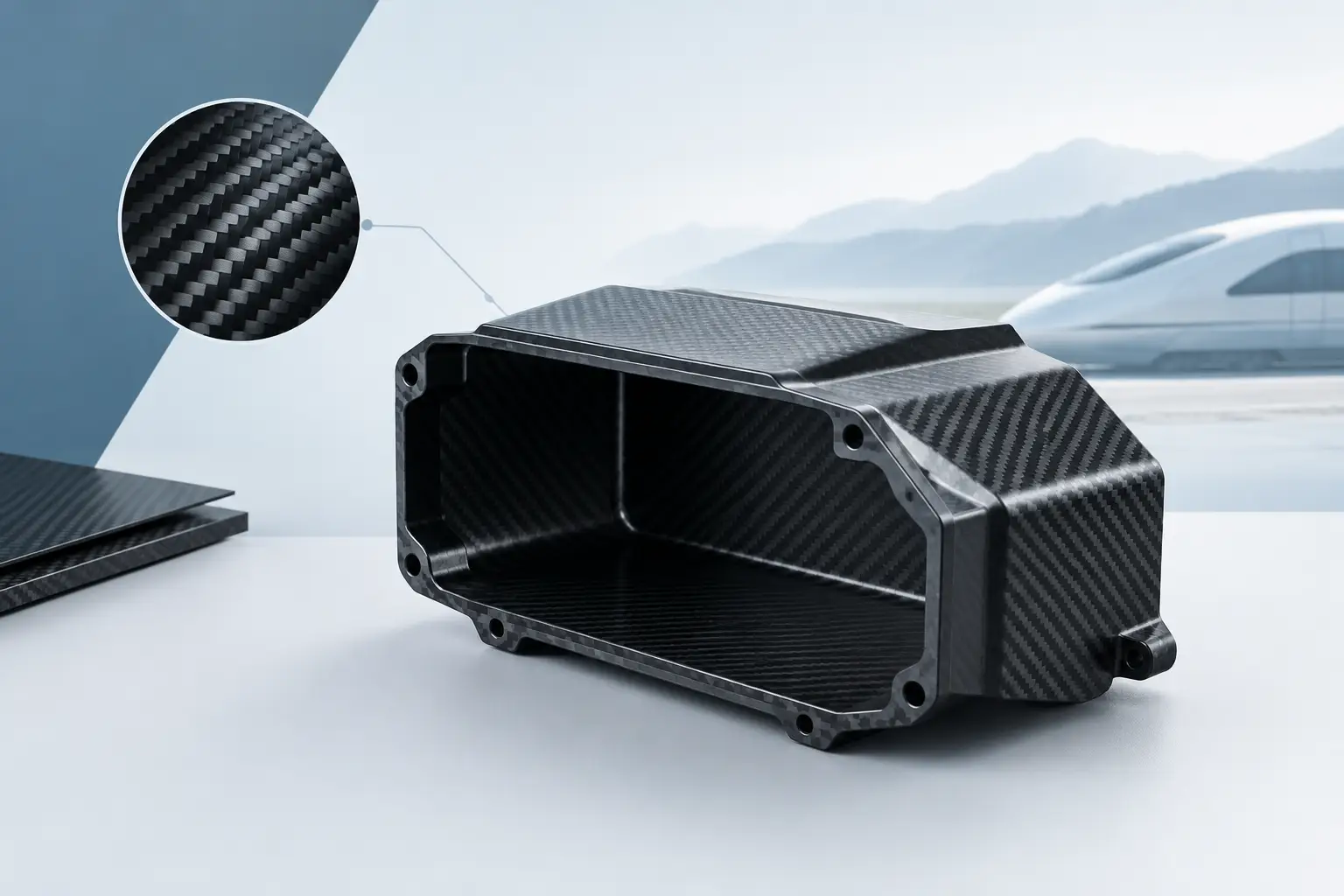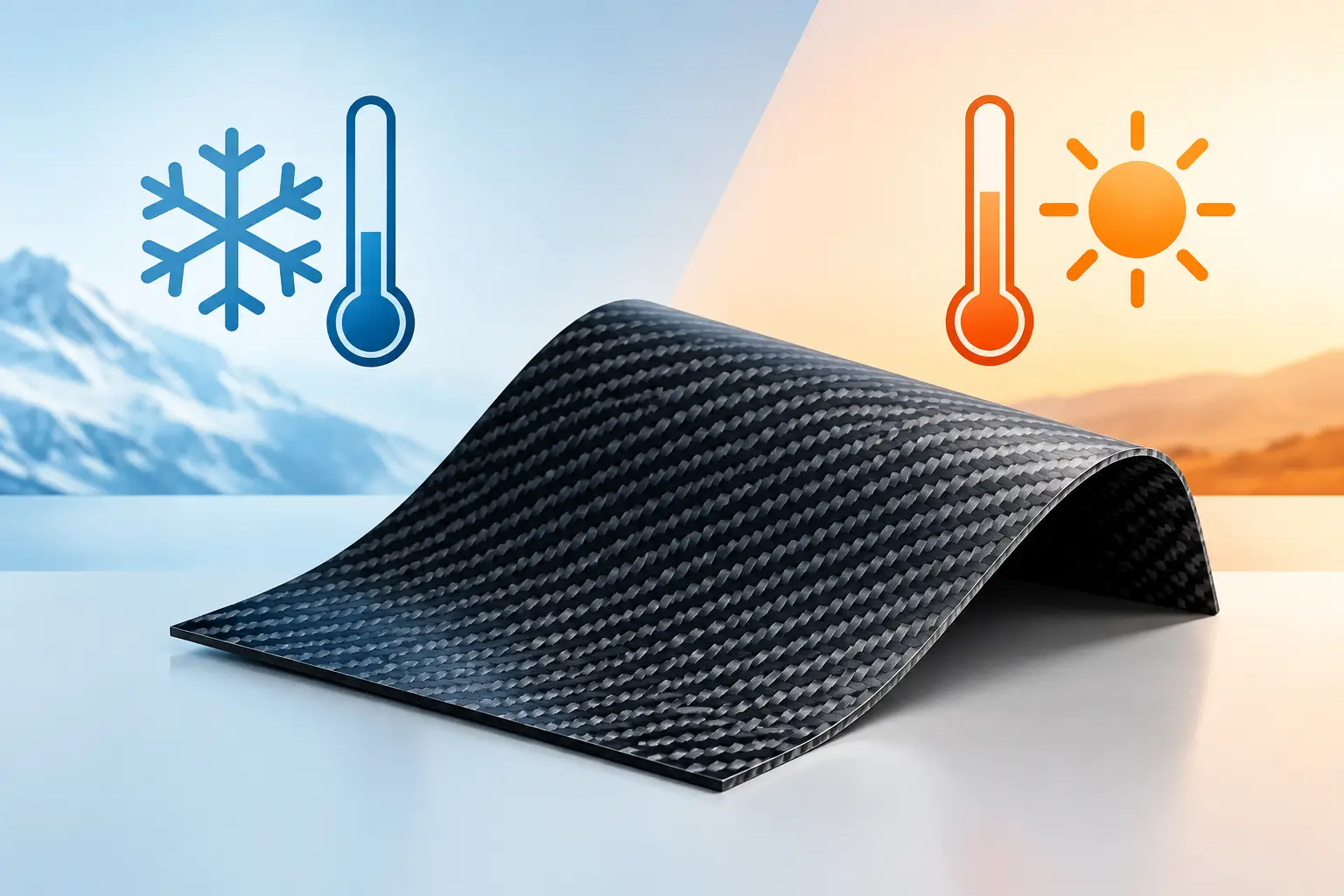
A carbon engine cover can remain dimensionally stable at 120 °C permanently, while a visually similar component may already lose stiffness at the same temperature. Therefore, there is no single, material-independent answer to the question “What temperature can CFRP withstand?” The decisive factor is not the carbon fiber alone, but primarily the resin system, the laminate structure, the mechanical load, and the duration of temperature exposure.
For technical applications in industry, automotive, and motorsport, temperature resistance must be defined as a system requirement. Those who only specify a maximum temperature risk incorrect material selection—especially for components near the engine, exhaust system, battery, braking system, or process heat.
## What temperature can CFRP withstand in practical use?
CFRP stands for carbon fiber reinforced polymer. The carbon fibers themselves are extraordinarily resilient thermally and retain their properties at temperatures far exceeding the usual requirements of a vehicle or industrial component. The limitation is almost always caused by the plastic matrix, usually an epoxy resin.
A standard epoxy laminate is often designed for continuous operating temperatures in the range of approximately 80 to 120 °C. High-temperature epoxy resins can allow for continuous temperatures of about 150 to 180 °C, depending on the formulation, curing, and component design. Special systems based on BMI, cyanate ester, or high-temperature resins reach higher ranges, but demand significantly more in terms of material costs, processing, tool technology, and quality assurance.
Short-term temperature peaks must not be equated with a permissible continuous operating temperature. A component can survive a short-term peak of 180 °C without immediate visible damage. However, under mechanical load, over many temperature cycles, or during longer hold times, the same value can lead to permanent deformation, cracking, or a loss of bond strength.
In practice, temperature resistance is always a combination of temperature level, duration of exposure, and load state. An unloaded visible carbon part presents different requirements than a load-bearing structural part that must absorb vibrations, pressure, or bending when exposed to heat.
## The glass transition temperature sets the decisive limit
The most important characteristic value for many CFRP components is the glass transition temperature, or Tg. Below this temperature, the cured epoxy matrix remains glass-like, rigid, and dimensionally stable. As the component approaches the Tg, the matrix becomes increasingly soft. While the fiber continues to carry a large portion of the load, the matrix becomes less effective at transferring forces between the fibers.
This can have several consequences: flexural stiffness decreases, boreholes and mounting points become more sensitive, the risk of delamination increases, and components can permanently settle under load. For visible components, there are also possible changes to the surface or the clear coat.
A Tg of 120 °C therefore does not mean that a component should be operated at 120 °C continuously without concern. In professional component design, an appropriate buffer from the Tg is planned. How large this safety margin must be depends on the load spectrum, safety requirements, temperature variance, moisture absorption, and desired service life.
Post-curing is particularly relevant. A Prepreg laminate manufactured [in the autoclave](https://composite-world.com/prepreg-autoklav-verfahren-vorteile/) under a controlled pressure and temperature profile achieves significantly more reproducible compaction and curing than a hand-laminated component with unclear process management. However, the Tg actually achieved depends not only on the resin, but also on whether the specified curing and post-cure profile was precisely followed.
### Curing temperature is not operating temperature
A common misconception is that if a CFRP component was cured at 120 °C or 180 °C, it must also withstand this temperature permanently in use. This is not automatically correct. Curing describes the process by which the resin is cross-linked. The permissible operating temperature, on the other hand, results from the Tg, mechanical characteristics at temperature, safety factor, and real component load.
A high-quality manufactured Prepreg component provides a very good foundation for thermally demanding applications. Whether it is suitable for a specific installation site is nevertheless only determined by the design of the entire system.
## Temperature is rarely the only load
In development, thermal requirements are often underestimated because the highest measured surface temperature is used as the sole benchmark. In reality, several influences act simultaneously. Hot air, radiant heat from the manifold or turbocharger, temperature gradients from airflow, and heat conduction via metallic fasteners can generate very different temperatures within a single component.
The direction of the load also counts. CFRP has very low thermal expansion in the fiber direction. The composite material behaves differently transverse to the fiber and especially through the laminate thickness because the matrix reacts more strongly to temperature. Repeated heating and cooling cycles create stresses at transitions, edges, inserts, and connection points.
Moisture exacerbates the situation for many epoxy matrix systems. If the resin absorbs moisture, the glass transition temperature can drop. A component that shows a sufficient reserve in a dry laboratory may lose stiffness earlier in a hot, humid climate or in a stressed outdoor area. For vehicles in the USA, strong regional differences are also relevant—from dry desert heat to hot and humid summer conditions.
## Typical temperature ranges by application
For exterior add-on parts, interior components, and many aerodynamic elements, standard or medium-temperature resistant epoxy systems are often sufficient. Direct sunlight, dark surfaces, and heated vehicle bodies must be taken into account. Especially with visible carbon, the clear coat used also determines color stability and surface quality.
In the engine compartment, a blanket assignment is not enough. Intake ducts, covers, and air channels can be exposed to relatively moderate temperatures depending on their position. In the immediate vicinity of the exhaust side, turbocharger, or catalytic converter, however, temperature ranges arise for which a standard epoxy CFRP is not suitable without effective shielding.
In motorsport, a high level of vibration and load is often added to the temperature. Here, heat shields, air gaps, metallic supports, or specifically placed insulation layers are often more sensible than simply using an increasingly temperature-resistant resin. A clever design controls the heat input instead of trying to compensate for it exclusively via the material.
For industrial fixtures, housings, or structurally relevant components, the process environment is decisive. Hot air, heating plates, steam, chemical media, and cleaning cycles can significantly change the requirements. Especially for permanently loaded components, temperature and load tests on representative samples should be part of the approval process.
## How to correctly specify a temperature-resistant CFRP component
A reliable inquiry does not begin with “CFRP, heat-resistant,” but with clear operating data. Required are the maximum continuous and peak temperatures, the exposure time, the location of the heat source, loads and vibrations, and the required service life. Equally relevant are media contact, moisture, UV exposure, and aesthetic requirements.
Subsequently, the resin system is selected and the laminate structure is matched to it. Fiber volume fraction, fibre orientation, wall thickness, core material, inserts, and the fastening concept influence how a component behaves under heat. An insulating spacer or a correctly placed heat shield can achieve more impact than a slightly higher Tg.
For demanding series and motorsport projects, the prepreg autoclave process creates a controlled basis: defined material quality, low porosity, high fiber volume fractions, and reproducible curing. At Composite World, these manufacturing parameters are merged with (https://composite-world.com/leistungen/) and component function. This is crucial when temperature resistance is not just meant to be on a data sheet, but must function reliably in real-world use.
## When CFRP is not the right solution
For permanently very high temperatures in direct proximity to exhaust or furnace zones, a metallic material, a ceramic solution, or a hybrid structure may be the better choice. CFRP is not a substitute for every heat protection application. Its strength lies where low weight, high specific stiffness, precise shaping, and defined load capacity come together.
The right question is therefore not just what temperature CFRP can withstand. The decisive factor is what temperature the specific component must reliably master under real load over its entire service life. Those who define this requirement clearly at an early stage will not receive a generically “heat-resistant” carbon part, but a technically resilient composite solution.