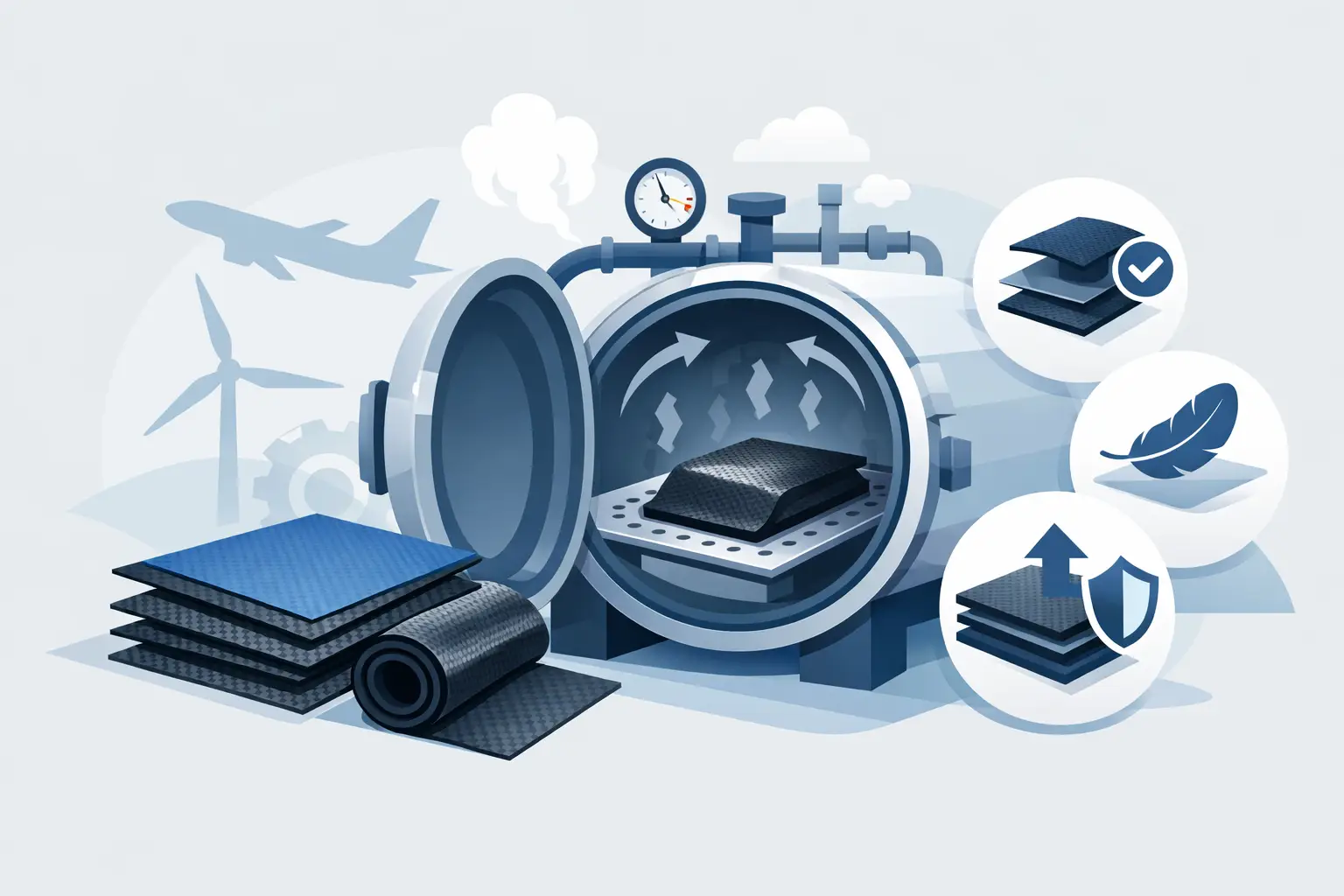
When a carbon part must not only look lightweight but also function under real loads, the show surface separates from true manufacturing quality. This is exactly where the advantages of the prepreg autoclave process become relevant: they concern not only weight and strength, but also dimensional accuracy, reproducibility, and the question of whether a part will last in long-term use.
Why the prepreg autoclave process is the standard in the high-performance sector
The prepreg autoclave process is not a marketing term for high-quality carbon, but a clearly defined manufacturing process. It involves processing pre-impregnated semi-finished fiber products with a precisely adjusted resin system. These materials are cut in a controlled manner, placed layer by layer into the tool, vacuumed, and then cured in the autoclave under temperature and overpressure.
The decisive difference compared to simpler processes lies in process control. Resin content, fibre orientation, consolidation, and curing conditions can be controlled much more precisely than, for example, with open wet laminates. For technical components with clear target values for stiffness, weight, and surface quality, this is not a detail, but the foundation for resilient results.
Particularly in motorsport, automotive, and industrial applications, it is not just the weight of a part that counts. It must also deliver the same quality reproducibly in series or small series production. Anyone using components in development projects, pre-series, or demanding end-use applications needs a process that does not have to be reinterpreted with every batch.
Advantages of the prepreg autoclave process in practice
The most important advantages of the prepreg autoclave process become apparent whenever high loads, tight tolerances, and optical requirements converge. In such projects, a “good carbon part” is not enough. What is required is a component that is convincing in terms of design, process reliability, and visuals.
High fiber volume with low weight
Prepreg materials already come with a defined resin content. This reduces fluctuations that inevitably occur with manual resin application. In combination with vacuum and autoclave pressure, a laminate structure with high compaction and low porosity is created.
For the user, this means: more structural performance per weight. A high fiber volume is not an end in itself, but directly relevant to stiffness and load-bearing capacity. This is a clear advantage, especially for components that are subjected to dynamic stress or must meet defined mechanical properties.
Excellent mechanical properties
The quality of a fiber composite component depends not only on the material name, but on the actual laminate quality. When fibers are cleanly oriented, layers are placed exactly, and the component is consolidated under controlled conditions, significantly better mechanical properties are achieved than with less controlled processes.
This applies to tensile and flexural strength as well as shear behavior, impact strength, and fatigue life. Which characteristic values can be achieved naturally depends on the fiber system, resin system, layup, and component design. However, the process creates the prerequisite for the material’s theoretical potential to be realized in production.
Precise and high-quality surfaces
In the visible carbon sector, the surface is never just cosmetic. It shows how cleanly the component was constructed and cured. The prepreg autoclave process enables very uniform visible surfaces with clear fabric representation, clean contours, and low susceptibility to excess resin, pressure marks, or uneven structures.
This is economically relevant for interior, exterior, or premium industrial components. Rework costs time, money, and often material substance. The more precisely the part comes out of the tool, the more efficient the overall process becomes.
Reproducibility for one-off parts, small series, and series production
Professional clients evaluate a process not just by the best individual part, but by its process stability. A part that succeeds excellently once is of little value for development and series projects if the next batch deviates visually or mechanically.
This is a central advantage of the prepreg autoclave process. Standardized material systems, defined storage conditions, regulated temperature cycles, and controlled pressure create reliable framework conditions. This is particularly relevant for components manufactured in pairs, those that must fit into assemblies, or those listed in technical documentation with clear specifications.
Where the advantages really count economically
The process is not automatically the best solution for every carbon part. This is precisely why economic classification is important. If you only need a simple cover with low structural function, you may be able to get by more cheaply with a simpler process.
However, as soon as several requirements must be met simultaneously, the evaluation shifts. A structural component with a visible surface, low weight, tight tolerances, and reproducible manufacturing quality can rarely be produced cleanly with improvised processes. In such cases, the higher manufacturing effort of the autoclave is justified by lower failure rates, less rework, and better component performance.
In motorsport, this calculation is often obvious. Every unnecessary gram, every imprecise fit, and every fluctuation in the laminate structure can have direct consequences. In industrial projects, the benefit is more evident in terms of service life, process reliability, and documentable quality. In the premium automotive sector, the optical requirement is an additional factor.
The limits of the process
Anyone speaking seriously about the advantages of the prepreg autoclave process must also mention its limits. The process is more complex in terms of materials and equipment. Prepregs require controlled storage, defined processing windows, and high discipline in handling. Added to this are tool quality, vacuum technology, and autoclave capacity.
The cost structure is also more demanding than for simple wet laminates or certain infusion processes. This affects not only material and equipment, but also personnel, process monitoring, and quality assurance. For purely price-driven projects without high technical or optical requirements, it is not always the right choice.
Furthermore, a premium process cannot compensate for weak design. If fiber orientation, core structure, load paths, or demoldability are not properly developed, even the best autoclave will not help. The quality of the result arises from the interplay of engineering, toolmaking, and manufacturing discipline.
Advantages of the prepreg autoclave process compared to wet laminate and infusion
In direct comparison to classic wet laminate, the lead is particularly clear in terms of consistency, fiber-resin ratio, and surface quality. Wet laminates can be useful for certain applications, such as prototypes with low loads or highly budget-driven components. However, they react much more strongly to manual influences and therefore often deliver greater variance.
Compared to infusion processes, the classification is more nuanced. Infusion can be very economically attractive for larger components, suitable geometries, and a well-designed process. In many cases, it is powerful and industrially sensible. The prepreg autoclave process plays to its strengths primarily when maximum laminate quality, precise surfaces, and the highest reproducibility are the priority.
It is therefore not about a blanket “better” in every situation, but about the appropriate process for the respective specifications. This exact distinction is crucial for professional procurers and developers.
Which components benefit the most
The process is particularly useful for structural carbon components, high-load brackets, aerodynamic components, housings with visual requirements, motorsport parts, as well as premium interior and premium exterior components. Hybrid assemblies with tight tolerances also benefit when carbon parts must be cleanly connected to metal, inserts, or other functional surfaces.
The more demanding the geometry, surface, and mechanical target values, the clearer the benefit. This also applies to small series in which each part must correspond as exactly as possible to the next. It is precisely at this interface of technology, optics, and repeatability that a specialized manufacturing partner shows their true value.
At Composite World GmbH, this process is therefore not the focus as a prestige technology, but as a tool for resilient results. In the end, what matters is not the name of the process, but whether the component is created cleanly in the tool, functions in use, and maintains the same quality across all batches.
What clients should look for when choosing a partner
Anyone awarding a prepreg autoclave project should not just ask about autoclave size or material brand. More important are the depth of process mastery, experience with similar load cases, the quality of the tools, and the ability to think development and manufacturing together.
A good partner recognizes early on whether a component really benefits from this process or whether an alternative process would be more economical. They talk about laminate structure, demolding, inserts, finishing, and the testing concept – not just about “noble carbon.” Because in the B2B environment, what counts in the end is not the effect when unpacking, but the technical and optical performance in real use.
Anyone wishing to procure carbon parts with high structural and visual quality should therefore not view the process in isolation. Only when material, design, tooling, and manufacturing consistently fit together does a lightweight component also become a resilient product with a reliable series result.