Those who want to have carbon parts manufactured aren’t just buying a lightweight component. Crucial factors include stiffness, surface quality, tolerances, and whether a carbon part functions reliably in everyday use, motorsport, or an industrial application. This is precisely where simple laminating work differs from robust composite manufacturing.
Having carbon parts manufactured means clearly defining the application
Many projects fail not due to the material, but due to unclear requirements. Carbon is not a standard material that can be arbitrarily transferred to any geometry. Fibre orientation, resin system, core material, wall thickness, and manufacturing process collectively determine how the carbon part behaves under load.
For technical buyers and developers, this means: Before submitting an inquiry, it should be clear whether the part primarily needs to save weight, provide high stiffness, achieve a Class A visible carbon surface, or absorb structural loads. A visible carbon cover for an interior follows different rules than a highly stressed bracket, an aerodynamic component, or a housing structure.
The more precisely the application is described, the more reliable the subsequent manufacturing design will be. This includes temperature range, mechanical stress, quantity, tolerance requirements, and desired surface quality. Defining these points early saves time, iterations, and unnecessary tool costs during the project.
Not every process delivers the same quality
When customers have carbon parts manufactured, discussions often focus only on price and delivery time. However, the manufacturing process is the decisive lever for real performance. Hand layup, vacuum infusion, RTM, and the prepreg autoclave process differ significantly in fiber content, void content, reproducibility, and surface finish.
Hand layup can be suitable for simple fairing parts or cost-sensitive applications. It is flexible but highly dependent on the manual process. For highly stressed or visually demanding carbon parts, this process quickly reaches its limits, especially if the carbon part quality needs to remain constant across multiple parts.
Vacuum infusion offers advantages for certain geometries and medium requirements. It can be economical when larger areas need to be produced. However, the carbon part quality heavily depends on process stability, venting, and resin flow. For high-precision technical components with maximum demands on laminate quality, it is not always the first choice.
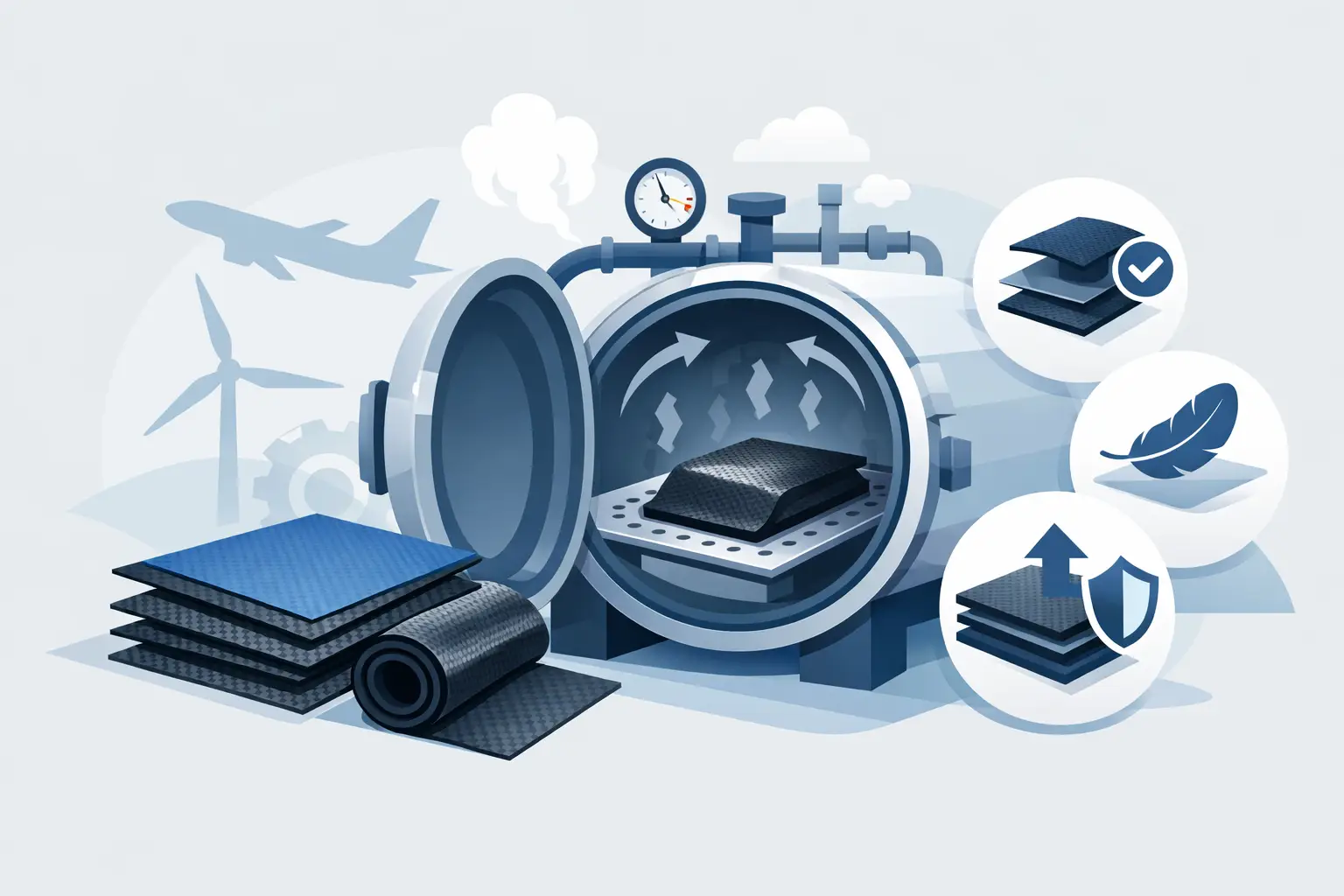
Prepreg in the autoclave, on the other hand, represents the premium segment of carbon manufacturing. The material is pre-impregnated with a precisely defined resin content, the plies can be laid up in a controlled manner, and a very dense, high-quality laminate is created under pressure and temperature. The result is reproducible properties, high structural performance, and a surface that makes a significant difference, especially for visible carbon parts.
For prototypes, motorsport components, technical small series parts, and demanding visible carbon parts, this process is often the right decision. It is not automatically the cheapest, but often the most economical when rework, scrap, and quality risks are realistically assessed.
Development and manufacturing must not be considered separately
A common mistake in composite projects is handing over a geometry that looks structurally sound but has not been fully thought through from a manufacturing perspective. For carbon, manufacturability significantly determines quality and costs. Tight radii, unfavorable parting lines, unnecessarily complex demolding directions, or poorly defined support points drive up effort and risk.
Therefore, the manufacturing partner should be involved not just during lamination, but already in design, prototyping, and tool design. A carbon part developed from the outset with composite-specific considerations generally achieves better mechanical properties and higher process reliability. At the same time, post-processing times decrease, and the tool can be more precisely adapted for subsequent small series production.
Especially for small series and performance-critical applications, this early integration makes all the difference. A well-designed carbon part is not only lightweight but also precisely matched to the application in its fiber architecture, reinforcement zones, and connection points.
Having carbon parts manufactured for prototypes, small series, or series production
The right manufacturing strategy heavily depends on the quantity. Different priorities apply to a functional prototype than to a recurring small series in the automotive or industrial sector. In prototyping, speed, technical validation, and the ability to adapt load paths or geometries at short notice are paramount.
In small series production, the focus shifts. It’s then about reproducible processes, robust tools, stable cycle times, and consistent quality from part to part. Those who only focus on low initial costs early on often pay later through increased rework, scatter in carbon part properties, or imprecise visible carbon surfaces.
In series production, design, mould making, and process windows must be consistently designed for repeatability. This is especially true when technical documentation, traceability, and defined quality standards are required. An experienced Composite World GmbH partner considers this scalability from the outset and does not base the project setup solely on the first sample part.
Visible carbon is not the same as technical carbon
Many inquiries focus on aesthetics. This is understandable, as visible carbon is a strong design element and often part of the product experience in premium and performance environments. At the same time, aesthetics must not come at the expense of function.
A purely visible carbon part can be constructed with different priorities than a structural carbon part. For visible outer layers, fiber pattern, symmetry, resin behavior, and finish are crucial. For highly stressed components, however, laminate layup, local reinforcements, delamination safety, and load-appropriate fibre orientation are paramount. In some projects, both requirements can be combined; in others, a compromise is necessary.
Precisely for this reason, an honest technical assessment is important. Not every perfect visible carbon surface is automatically the best solution for maximum load absorption. And not every structurally optimized laminate produces the desired show surface without additional effort. Good manufacturing recognizes when aesthetics and mechanics can be achieved in parallel and when priorities must be clearly set.
What distinguishes a reliable manufacturing partner
Anyone looking to have carbon parts manufactured needs more than just a supplier with laminating experience. Relevant factors include manufacturing depth, material knowledge, tooling expertise, and the ability to technically justify decisions. This starts with selecting the appropriate resin system and doesn’t end with clean trimming, but encompasses the entire process from CAD to the finished carbon part.
A capable partner can explain why a specific layup is chosen, where risks lie in the geometry, and which process truly fits the quantity, load case, and surface requirements. They can also transparently assess where carbon offers clear advantages and where aluminum, GRP, or a hybrid concept would be more economically sensible. This differentiation is often more valuable for professional clients than any blanket promise.
This is precisely where Composite World GmbH’s strength lies: Development, mould making, tool manufacturing, prototyping, and small series production are integrated. This creates short technical paths and increases process control, especially for demanding prepreg autoclave process carbon parts for motorsport, automotive, and industry.
Costs don’t just arise in the quote
Carbon is considered high-priced. While true in many cases, this assessment is too simplistic. The relevant question is not what a carbon part costs on paper, but what it actually incurs in operation, project execution, and quality assurance.
An inexpensive carbon part quickly becomes expensive if dimensional accuracy is lacking, visible surfaces require rework, or mechanical performance varies between batches. It becomes even more critical if development time is lost because prototypes do not allow for reliable conclusions for subsequent series production. In professional applications, therefore, the overall calculation of manufacturing, function, risk, and repeatability counts.
Conversely, not every high-end process is automatically the most economical solution. If a carbon part has no structural relevance and is only needed in small quantities for a simple application, a less complex process may be sensible. The crucial factor is that the process and requirements match.
How an inquiry becomes a successful carbon project
The best results are achieved when technical data is fully available early on. This includes CAD data, application description, load assumptions, temperature requirements, desired surface, quantity, and target date. If sample parts, reference geometries, or installation situations are available, this significantly accelerates the feasibility assessment.
Equally important is openness to manufacturing-friendly adjustments. In the composite sector, many problems cannot be solved by greater diligence in manufacturing, but only by better geometry, more sensible partitioning, or an adapted laminate layup. Those who allow for this loop early on will ultimately receive a carbon part that not only looks good but also functions technically and economically.
Carbon is strong when development, material, and manufacturing are considered as a single unit. Anyone who places this demand on their project should not just order a carbon part, but choose a partner who understands loads, processes, and quality with the same rigor as the final product itself.